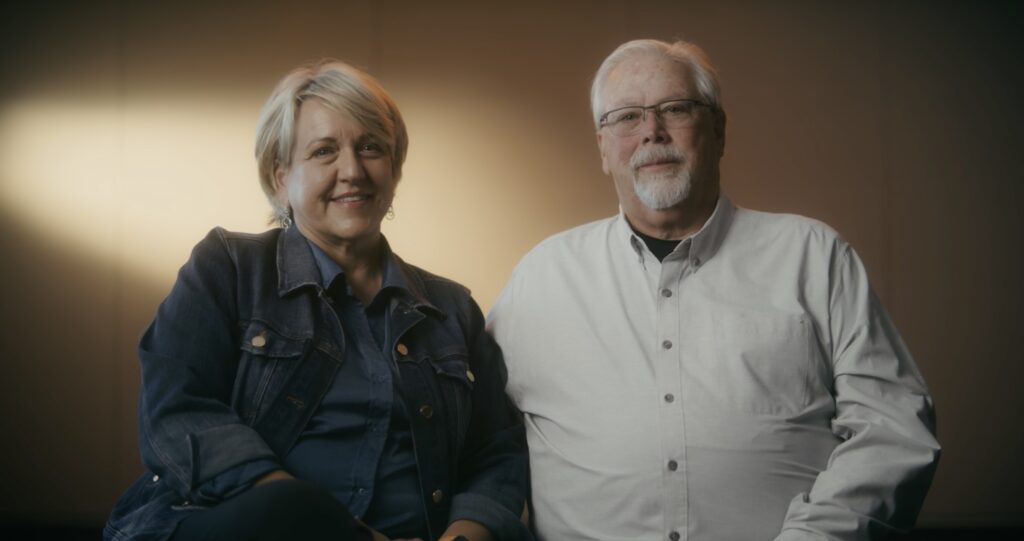
For Vance Hunter, life once moved at the pace of business deals, ranch work and community involvement. That rhythm changed in 2018 with a routine annual physical that revealed something far more serious than expected.
“There were no signs,” Vance said. “I just took a blood test. Next thing I know, I’m at a urologist. Next thing I know he is talking about cancer.”
What followed has not been a single chapter, but an ongoing story—one marked by aggressive prostate cancer, repeated emergency situations and a constant awareness of time. “You have no control. First-time in my life I haven’t had control,” Vance said. “The unknown is scary.”
His illness has reshaped how he lives each day. “I’m on the clock,” he said. “I live in two-hour to four-hour increments… with the cancer I live in 90-day to 60-day increments.”
But while Vance carries the physical burden of the disease, his wife, Lori, carries a different weight—one less visible, but equally consuming.

Years before the cancer diagnosis, the couple faced another life-threatening crisis. What began as a routine gallbladder surgery spiraled into complications that left Vance on life support.
“He popped a clamp and bled out, had to go back into surgery,” Lori recalled. “He had a reaction… and he went into full pulmonary arrest and had to be intubated and was on the ventilator for 11 days.”
During that time, Lori rarely left his side. “I spent that entire hospital stay with him watching his oxygen numbers,” she said.
That experience would shape how she approached every crisis that followed. When emergencies now arise—often suddenly due to complications from cancer treatment—Lori shifts instantly into what she describes as “mama bear mode.”
“I just go into protective mode,” she said. “You just want to protect him because he’s lying in a bed helpless.”
For Vance, those moments are marked by sudden medical emergencies tied to complications from his cancer treatment. What began as a long-term battle with prostate cancer has, at times, escalated into acute situations where scar tissue and internal bleeding can quickly become life-threatening. When these episodes occur, the bladder can fill with blood and urine, creating severe pain and an immediate need for emergency intervention—making proximity to care essential.
These episodes frequently send him to the emergency room, where rapid response becomes critical. “Sometimes they’re large bleeds, and you’re in trouble,” he said.
Despite the ongoing uncertainty, Vance points to the care he has received locally as a stabilizing force in an otherwise unpredictable journey. “The Stillwater Medical Center is amazing,” he said. “They take great care of me. They know when I come in, they know what the problem is.”
For Lori, the same moments require steadiness. “Everything kind of slows down for me and I just try to figure out what the next steps need to be,” she said. “The calmer I can be, the better it is for Vance.”
The contrast in how they process fear has become a quiet strength in their relationship. While Vance confronts the reality of his condition head-on, Lori deliberately holds off on fear until it becomes unavoidable.
“I’m not going to anticipate anything negative until it’s in black and white,” she said. “I can’t go there until I’m there.”
Still, the emotional toll is undeniable. “I can’t fathom him not being here,” Lori said. “He is my person. He is my rock.”
That reality often goes unspoken between them. Lori admits she shields Vance from her own fears, choosing instead to remain a steady presence. “All I can do is just be calm,” she said.
For Vance, the mental weight of illness is constant, especially in moments of waiting. “The scans scare me,” he said. “They just destroy my energy, because of the what ifs.”
Even in those moments, Lori’s role remains the same: to steady what feels unsteady.
Caregiving, however, is not confined to hospital rooms. It extends into daily life—into managing a home, responsibilities and the emotional strain that lingers long after a crisis ends.
“I think I probably had a little touch of PTSD after that for maybe a year,” Lori said, reflecting on the aftermath of Vance’s time on life support.
Despite the strain, their bond has endured. “We have a really, really strong bond,” Lori said. “You just have to lean on your relationship.”
Vance recognizes that his journey is not his alone. “It’s a burden not just on me, it’s on the burden on everybody else,” he said.
That shared burden—patient and caregiver, illness and endurance—defines their story. It is not just about survival, but about partnership in its most tested form.
And while Vance continues to measure life in increments shaped by uncertainty, Lori remains beside him, steady in moments when everything else is not.
Their story offers a rare, dual perspective—one from the patient navigating illness, and one from the caregiver quietly carrying its weight alongside him. To hear more from Vance and Lori in their own words, including the full conversations behind these moments, listeners can visit the Still Caring podcast, at https://www.stillwater-medical.org/stillcaring/, where both episodes are available.