Writer: Erica Davis
For many physicians, practicing medicine is about treating disease. For Dr. Daniel Roton, it is also about serving the community that helped shape him. Born at Stillwater Medical Center, raised in Stillwater, and now caring for patients in the very town he called home, Roton represents a full-circle story of dedication, compassion, and hope.
“Stillwater became home the day I was born,” Roton shared during a recent episode of the Still Caring Podcast. After leaving to pursue his education and medical training, he never imagined he would one day return to practice medicine in his hometown. Yet when the opportunity arose, he knew it was exactly where he was meant to be.
What drew him back was more than nostalgia. It was a desire to fill a critical healthcare need. Roton recognized that pulmonary care was largely unavailable in the community, forcing many residents to travel elsewhere for specialized treatment. The issue was personal. His own grandparents struggled with lung disease and experienced firsthand the burden of seeking care outside of Stillwater.
“Being able to fill that gap here in my hometown was an opportunity I couldn’t pass up,” he said.
Today, Roton serves as both a pulmonologist and critical care physician, caring for patients with conditions ranging from asthma to life-threatening illnesses in the intensive care unit. While he is passionate about all aspects of his specialty, he spoke specifically about one area of medicine experiencing rapid advancement: lung cancer detection and treatment.
“Lung cancer is the number one cause of cancer-related deaths in the United States,” Roton explained. One of the greatest challenges is that early-stage lung cancer often develops silently, without symptoms. By the time many patients realize something is wrong, the disease has already progressed.
Fortunately, new screening technologies are changing that reality.
Roton now uses advanced diagnostic tools that can help identify cancer earlier than ever before. Among them are blood tests that detect circulating tumor DNA, helping physicians better determine whether a suspicious lung nodule is likely cancerous. Combined with low-dose CT screenings and minimally invasive lung biopsies, these innovations allow patients to receive answers sooner and begin treatment faster.
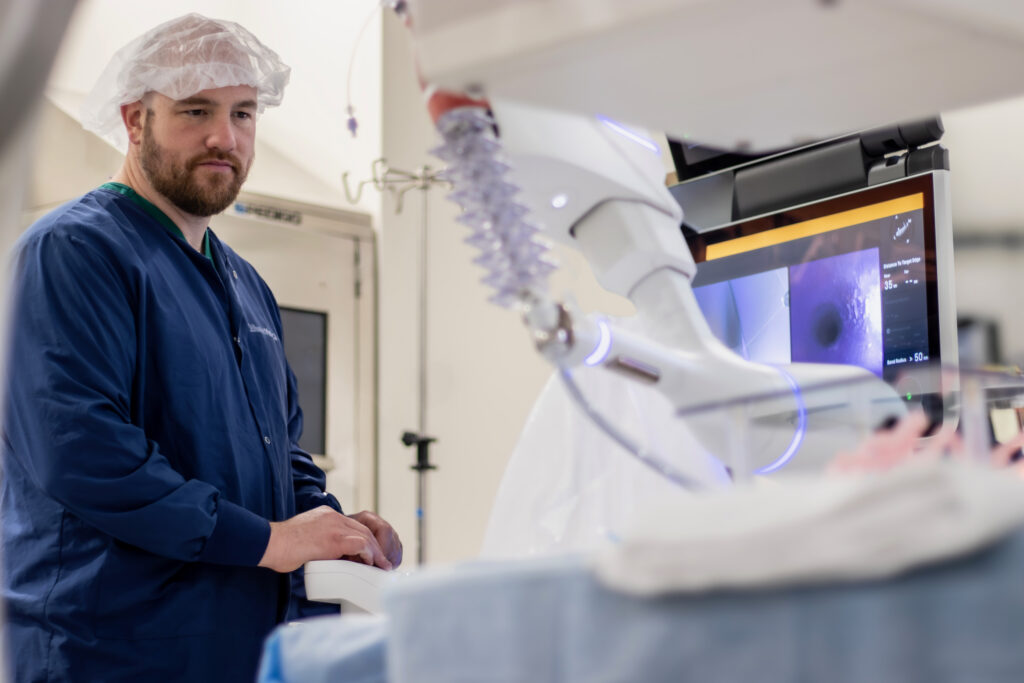
Perhaps most remarkable is the robotic bronchoscopy technology now available at Stillwater Medical Center. Using the Ion robotic platform, Roton can navigate deep into the lungs and biopsy tiny nodules through a patient’s airway while they are asleep.
“It’s hardly invasive at all,” he explained. “I just go down their airway, take a little biopsy, come out, and it’s about a 45-minute procedure total, and then they get to go home that same day.”
The difference compared to traditional methods is significant. Older biopsy techniques carried a much higher risk of complications, including collapsed lungs. With robotic bronchoscopy, that risk has been reduced dramatically, allowing patients to receive safer, more precise care close to home.
These advances matter because timing matters.
“If we look at lung cancer overall, we break it down into stages,” Roton explained. “Stage one and stage two lung cancers—meaning that they’re confined right there and have not had a chance yet to spread—those are treatable and often curable.”
Early detection can mean the difference between a patient moving forward with a healthy future or facing a much more difficult battle. Roton has witnessed those victories firsthand, and they remain some of the most rewarding moments of his career.
“The feeling, the rewarding feeling that I get from that is just…nothing rivals that,” he said. “Someone who had lung cancer, they don’t anymore, they have their whole life ahead of them, and that is so rewarding.”
What makes these accomplishments even more meaningful is that they are happening in Stillwater. Through close collaboration with the Stillwater Cancer Center and access to advanced technology, patients are receiving world-class care without leaving their community.
“This is my hometown, and we are able to do this,” Roton said proudly. “We’re competing with the majority of the big tertiary centers. In fact, I would argue that we’re doing it better because we are able to do it quicker.”
At its heart, Roton’s story is not simply about technology or medicine. It is about people. It is about a physician who returned home to make a difference, a community benefiting from life-saving innovations, and patients finding hope in moments that once felt uncertain.
His perspective has been shaped by years of caring for individuals during some of life’s most vulnerable moments. Through it all, one lesson stands above the rest.
“Life is fragile,” Roton reflected. “You really do need to enjoy every day as a gift.”
Thanks to physicians like Roton and the continued advancement of lung care in Stillwater, more patients are being given exactly that gift: the opportunity for healthier tomorrows, right here at home. Visit www.stillwater-medical.org/stillcaring to listen to Roton’s full episode.